30 September 2026 · Malaysia
Malaysia has attracted the infrastructure. Now comes the opportunity around it.
As Malaysia moves into semiconductors, AI infrastructure and higher-value industry, a new market is emerging for the technologies, companies and investors that can help build the ecosystem around them.
The next phase
Infrastructure · Industry · Ecosystem
Malaysia is already an established part of the global technology supply chain. Decades of semiconductor manufacturing have created substantial industrial capabilities, particularly across Penang and Kedah.
Today, a new wave of investment is adding data centres, AI infrastructure, advanced manufacturing, energy capacity and increasingly sophisticated semiconductor activities.
The scale of this transformation is significant, but the more interesting story may be what happens next. Once fabs, data centres and industrial infrastructure begin to arrive, they create demand for an entire ecosystem of technologies, suppliers and capabilities around them.
This is where a new opportunity is opening.
From building infrastructure to building the ecosystem
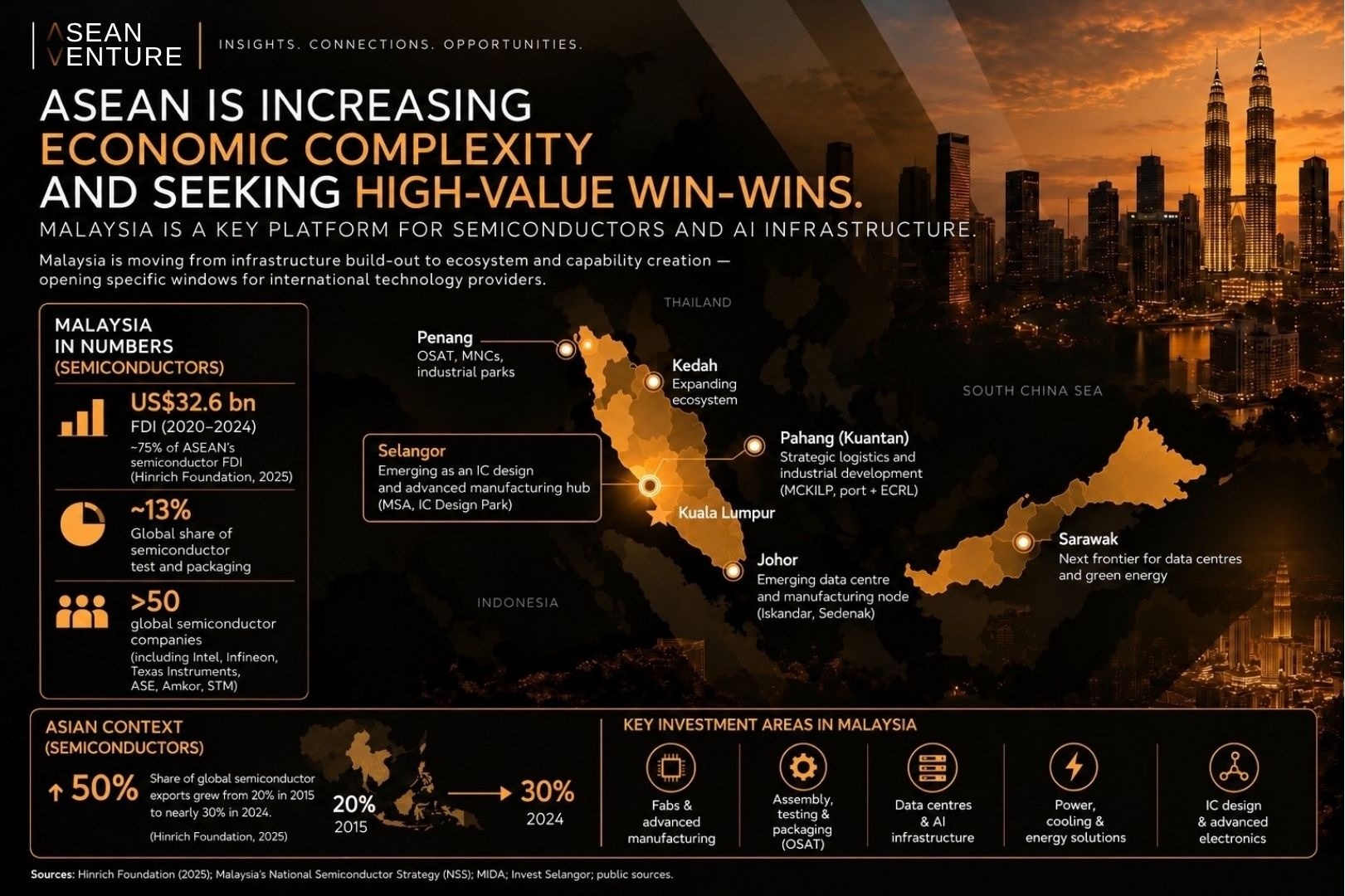
Malaysia's National Semiconductor Strategy illustrates the direction of travel. The country wants to move further into activities such as IC design, advanced packaging, manufacturing equipment and other higher-value parts of the semiconductor industry. The strategy targets at least RM500 billion in investment while seeking to develop Malaysian semiconductor companies and 60,000 highly skilled engineers.
A similar transition is happening around digital infrastructure. Malaysia has attracted major data-centre investment, particularly around Johor, but attention is increasingly turning towards the economic activity that can be created around those assets. MIDA has itself described the next phase in terms of moving beyond investment attraction and increasing participation by Malaysian companies and suppliers.
This matters because a data centre is not simply a building full of servers, and a semiconductor fab does not operate in isolation. Both depend on a much wider technology ecosystem.
01
Power and grid infrastructure
02
Cooling and energy storage
03
Fibre and optical connectivity
04
Automation and industrial software
05
Advanced manufacturing and semiconductor equipment
06
AI and compute technologies
As more infrastructure is built, new needs appear around it. For technology companies able to solve those needs, this creates opportunities that did not exist at the same scale only a few years ago.
Different opportunities are emerging across Malaysia
These opportunities are not concentrated in one place. Different parts of Malaysia are developing increasingly complementary roles.
Penang and Kedah remain at the heart of the semiconductor and electrical and electronics ecosystem, with continued investment in manufacturing and specialised industrial capabilities. In 2026, for example, AIXTRON announced a new advanced semiconductor equipment manufacturing facility in Penang.
Selangor is developing capabilities around IC design, advanced manufacturing and the digital economy, while Johor has become a major centre for data-centre and digital-infrastructure development. Other parts of the country connect these clusters with energy, logistics, ports and industrial development.
Taken together, this is creating something more interesting than a collection of individual investments. Malaysia is gradually building a more complex technology and industrial system in which semiconductors, AI infrastructure, energy, connectivity and advanced manufacturing increasingly depend on one another.
That creates multiple entry points for international technology companies. A European company may find an opportunity supplying a technology into an existing project, working with a Malaysian industrial partner, supporting a new infrastructure requirement or contributing a capability that the local ecosystem is actively trying to develop.
The important point is that there is no single route into this opportunity.
Regional context
Malaysia is part of a bigger ASEAN transformation
The same process is taking place across Southeast Asia. ASEAN's role in semiconductor supply chains has expanded significantly over the past decade. Research by the Hinrich Foundation estimates that the region's share of global semiconductor export growth increased from approximately 20% in 2015 to nearly 30% in 2024.
Countries across the region are now trying to capture more sophisticated parts of technology value chains. Malaysia has particularly strong foundations from which to do so, combining an established semiconductor and electronics industry with growing digital infrastructure, industrial capacity and connectivity to the wider ASEAN market.
AI is accelerating this convergence. Advanced packaging, high-performance computing, power semiconductors, silicon photonics, data centres, high-capacity networks and energy infrastructure increasingly form part of the same industrial conversation. Malaysia's investment outlook already identifies areas such as advanced packaging for high-performance computing and silicon photonics for data-centric infrastructure among the capabilities relevant to the country's next phase.
For international companies and investors, that makes this a particularly interesting moment to pay attention.
The opportunity is real. Capturing it is harder.
None of this means that entering Malaysia or Southeast Asia is easy.
Precisely because the opportunity is becoming visible, competition is increasing. European technology companies are competing with established Asian, American and regional players, many of which already have significant resources and local relationships.
A strong technology is therefore an important starting point, but it does not automatically translate into a market position.
The real challenge is understanding where that technology has a genuine reason to win. Not every project is the right project, not every potential customer is the right customer, and not every market opportunity justifies the time and resources required to pursue it.
For a scale-up approaching the region from Europe, navigating those choices can be particularly difficult. The market can look extremely attractive from a distance while remaining hard to access in practice. The companies that succeed will need to identify where their capabilities are genuinely relevant and find a credible way to become part of the industrial ecosystems now being built.
The same applies to investors. A large investment pipeline does not by itself show where long-term value will be captured. As these ecosystems become more sophisticated, some of the most interesting opportunities may emerge not only from the largest infrastructure assets, but from the technologies, capabilities and companies required to make those assets work.
This is the moment to become part of what is being built
Malaysia is moving from attracting individual technology investments towards building a broader ecosystem around them. That transition will take years, but many of the positions within that ecosystem are being established now.
For international technology companies, this creates an unusual window. The opportunity is not simply to sell products into a growing market. It is to become part of the infrastructure, industrial relationships and technology capabilities that will support Malaysia's next phase of development.
Doing that from thousands of kilometres away is difficult. Understanding where to start, which opportunities deserve attention and how to turn initial interest into a real position in the market requires local context and continuity.
That is where ASEAN Venture comes in.
From Malaysia, we help international technology companies and investors understand where the strongest opportunities are emerging, navigate a complex and highly competitive environment, and develop a credible path into the ecosystems being built across Southeast Asia.
We do not believe every technology should enter every market. The objective is to identify where there is a genuine fit and, when there is one, help companies move from watching the opportunity from the outside to becoming part of it.
Because Southeast Asia's next phase of growth will not only be about the infrastructure being built. It will also be about who provides the technology, capabilities and capital around it — and who earns a place in the ecosystems that emerge.
ASEAN is increasing its economic complexity. Malaysia is one of the places where that transition is particularly visible. And for companies and investors with the right capabilities, this is a moment worth testing.
To explore the opportunity, contact ASEAN Venture at asean@futureliteracy.eu.